A team of NASA researchers is developing new types of optical masks that could help enable the many orders of magnitude of starlight suppression needed for future space observatories to pick out very faint habitable exoplanets from the far brighter glare of their stellar hosts.
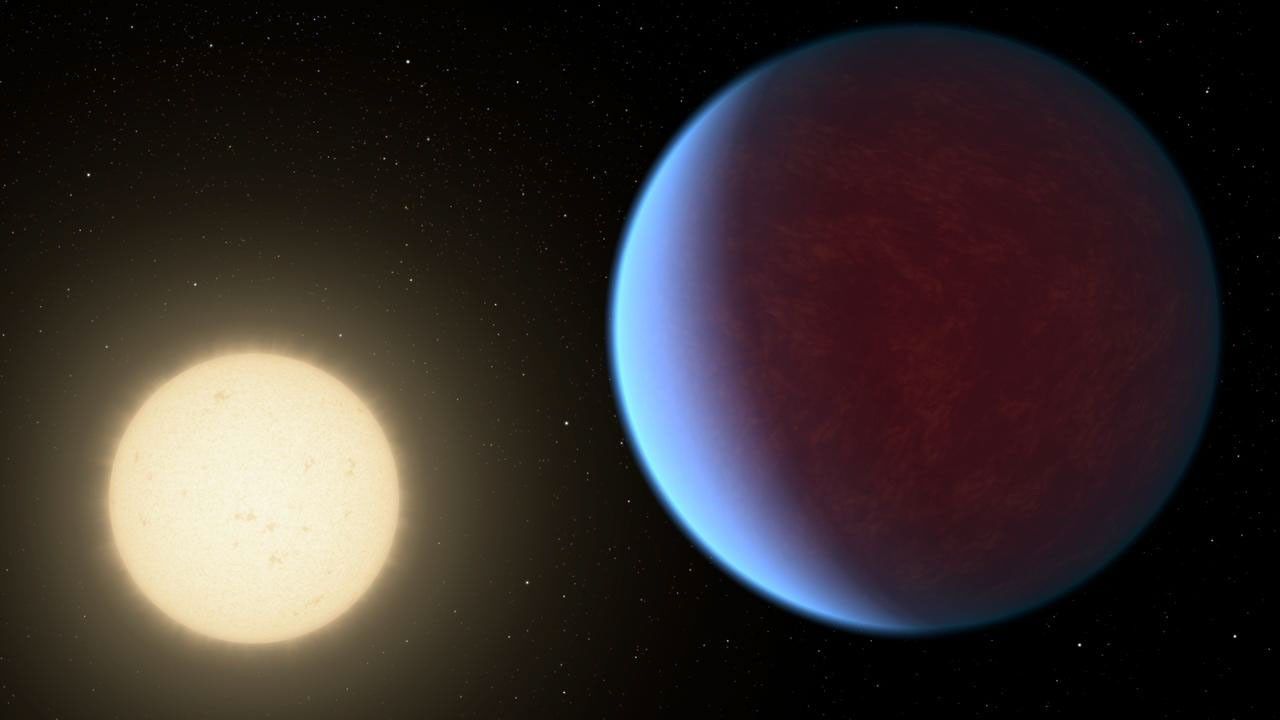
One of the goals of NASA’s Astrophysics Division is to carry out a census of nearby solar systems to search for habitable worlds around nearby stars, and ultimately, to determine whether life might be present outside our own solar system. Because other stars are so far away, we must rely on remote observations of these systems, and in particular, on the spectroscopy of any planets present (i.e., on the examination of their color characteristics to determine their atmospheric characteristics). NASA’s future Habitable Worlds Observatory (HWO) mission will be the first telescope designed specifically to search for signs of life on planets orbiting other stars.
Significant progress has been made over the past couple of decades in observing the brightest and often largest exoplanets, especially those that happen to pass in front of their stars, allowing us to see the planet’s atmospheric constituents that absorb particular colors of the host star’s light. However, most exoplanets are not so favorably aligned; to detect them, HWO must be able to distinguish the very small bit of light coming from an exoplanet from the overwhelming glare of the very bright nearby host star. For example, an Earth-like planet orbiting a star similar to our Sun would be only about 1 ten billionth as bright as its host star. An apt analogy is the light from a firefly flying right next to a lighthouse!
To see faint potentially habitable worlds in nearby solar systems, we must remove the incoming starlight to such an extent that the much smaller bit of light arriving from the exoplanet can be distinguished. Unfortunately, telescopes don’t produce perfect point-like images of stars. Two contributing factors–scattering and diffraction—blur and spread the starlight across the region of the image where exoplanets are likely to be found.
Scattering of starlight is caused by surface irregularities in the mirrors that make up the telescope’s optical system. These irregularities can be mitigated by using a high-performance adaptive optics system to correct the wavefront errors. But even with a perfectly corrected optical system, diffraction must also be mitigated.
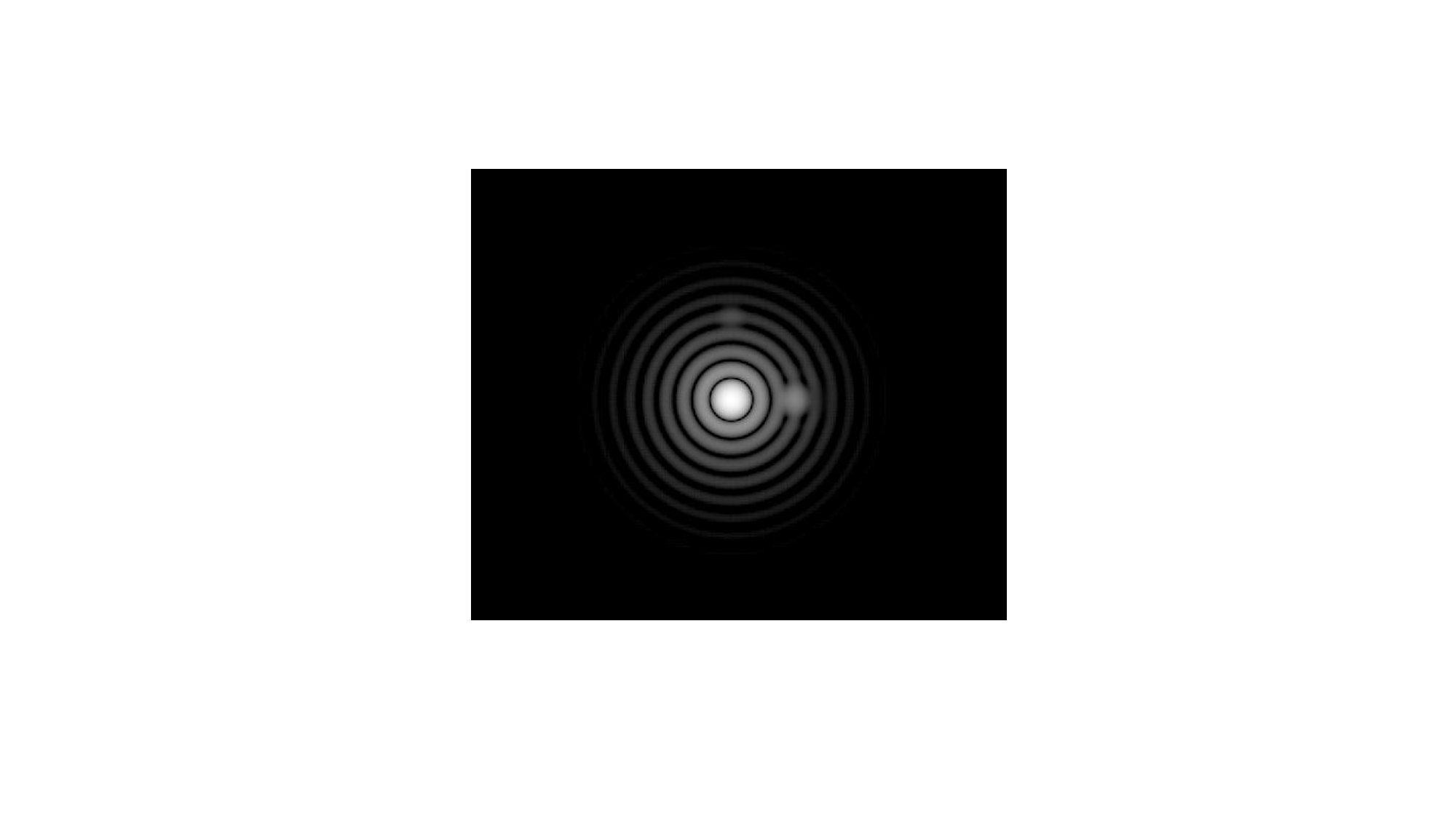
Diffraction is the angular spread of a light beam (or of any type of wave, including water or sound waves) that occurs as the wave passes through an aperture, such as a telescope’s light-collecting mirror. Diffraction causes the starlight to spread across the focal plane into a ringed light distribution called an Airy pattern (see figure below). Since this Airy pattern can be many times brighter than the light emitted from an exoplanet, it also needs to be removed.
Suppression of the Airy pattern’s rings is usually done with an optical instrument known as a coronagraph. The coronagraph was invented a century ago to allow astronomers to see the faint solar corona that surrounds the Sun. When applied to other stars, a coronagraph can enable us to see faint exoplanets near their much brighter stars.
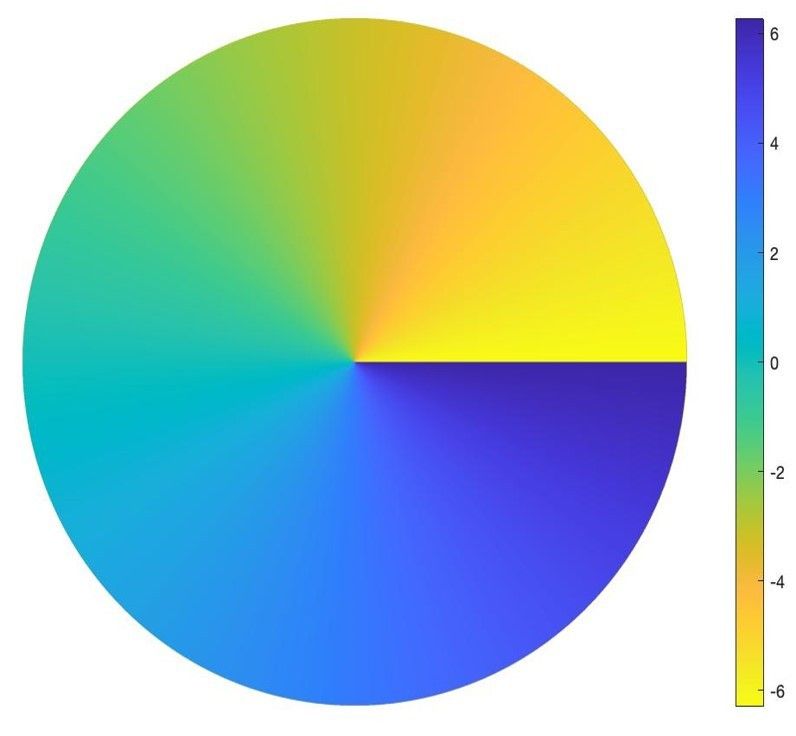
The core component of most coronagraphs is an optical mask—a small piece of glass with a special surface coating or surface shape that is designed to either selectively attenuate or delay the light distribution making up the stellar image. One particularly promising type of optical mask is the optical vortex phase mask, which applies a phase delay that increases in proportion to the azimuthal angle around the center of the mask (see figure below). When centered on the stellar Airy pattern, the mask thus applies delays that increase along the Airy rings.
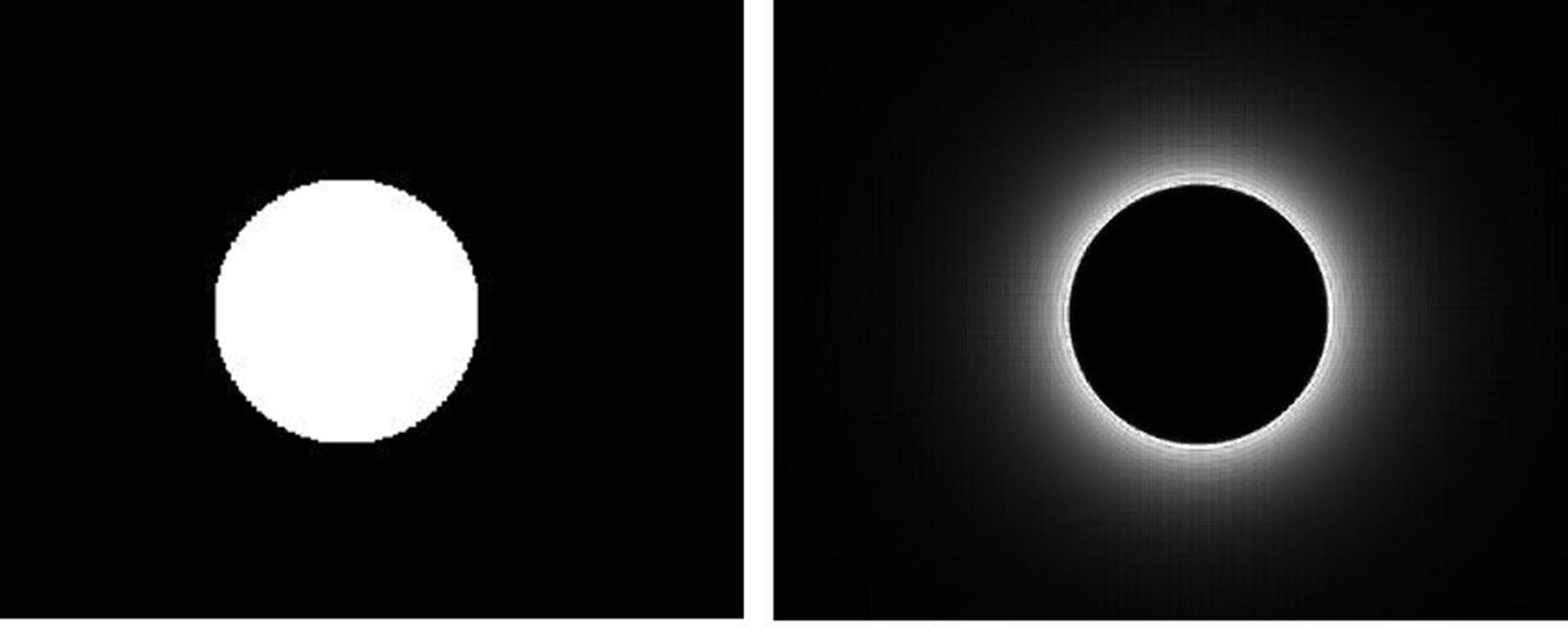
This delay pattern, which is somewhat analogous to the helical surface of a screw thread, causes the starlight to destructively interfere in such a way that if one reimages the telescope aperture downstream of the vortex mask, no starlight remains inside that aperture image. Instead, the starlight is only seen outside of where the filled telescope aperture image is expected to be, where it can then be easily blocked by a simple aperture stop, as is used in photography. (The figure below depicts images of a telescope aperture in advance of and downstream of the vortex mask.) Since the light from the exoplanet typically hits the vortex mask off-center, it propagates unchanged through the aperture stop to reach the detector, where it can be successfully imaged.
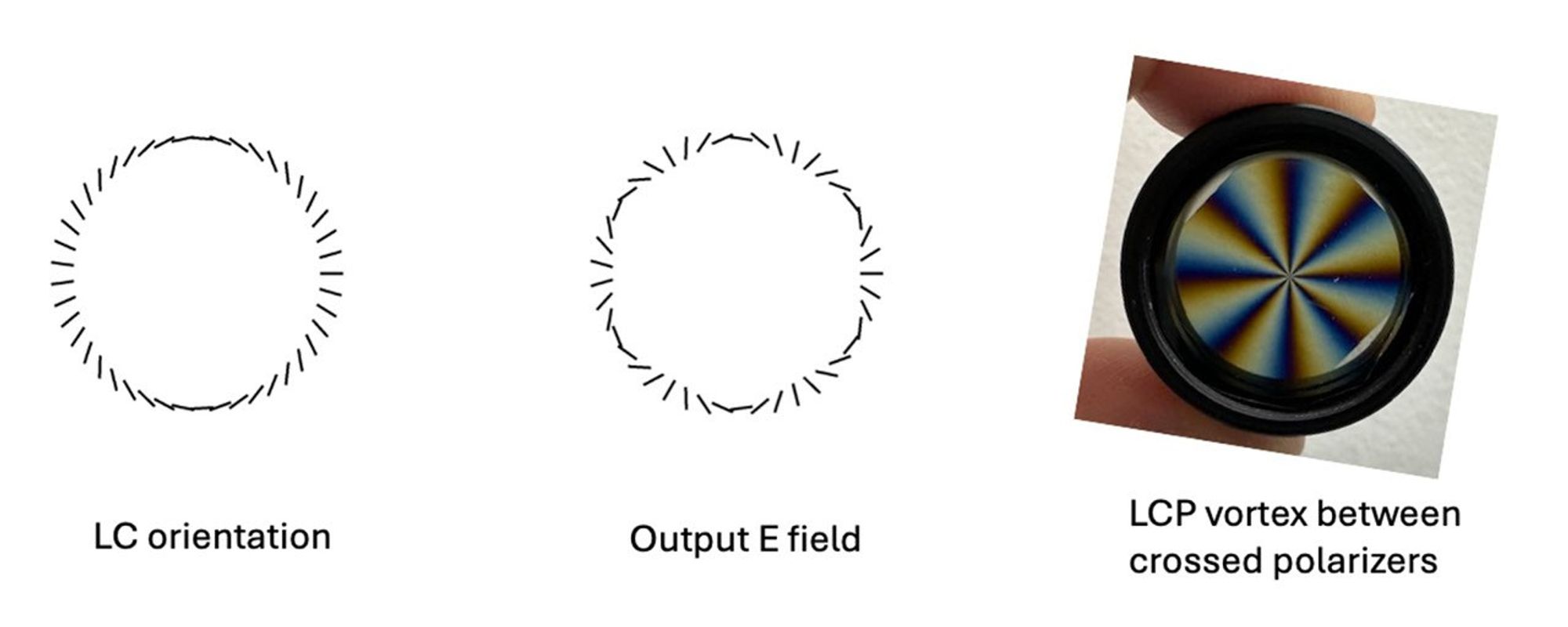
Fabricating vortex masks is challenging since they must be able to simultaneously reject starlight over a wide range of wavelengths. A team of technologists at the NASA Jet Propulsion Laboratory (JPL) is investigating a number of different technologies that could be used make optical vortex masks with the desired characteristics. To date, the most promising approach uses a flat layer of a specially prepared liquid crystal polymer (LCP) to provide the required optical delay pattern. The long molecular polymer chains making up the LCP layer can be specifically oriented to induce different delays in the two polarization directions of light. (Polarization refers to the direction of oscillation of the electric field vector in a propagating light wave, i.e., whether it is up-down or left-right). Depending on whether the electric field vector lies along or perpendicular to the long LCP axis, the light experiences different delays.
Moreover, if the LCP layer is laid down in a pattern wherein the long LCP axis rotates while following a circular path around the mask’s center (reaching a multiple of a full molecular rotation in a full circuit around the center), the desired delay pattern can be achieved (see figure below). The main advantage of such masks is that since their phase delays are induced geometrically (i.e., by a purely geometric orientation pattern) they are wavelength-independent to first order, and can reject starlight over a wide range of wavelengths.
The JPL team has recently advanced these masks to the point where the light from an artificial “star” can be rejected in the laboratory to about one part in a billion (with the single-wavelength rejection even better), which is within about an order of magnitude of the ultimate 10 billion-to-one rejection needed for the HWO. The team is currently working on further mask improvements to achieve that last factor of ten.
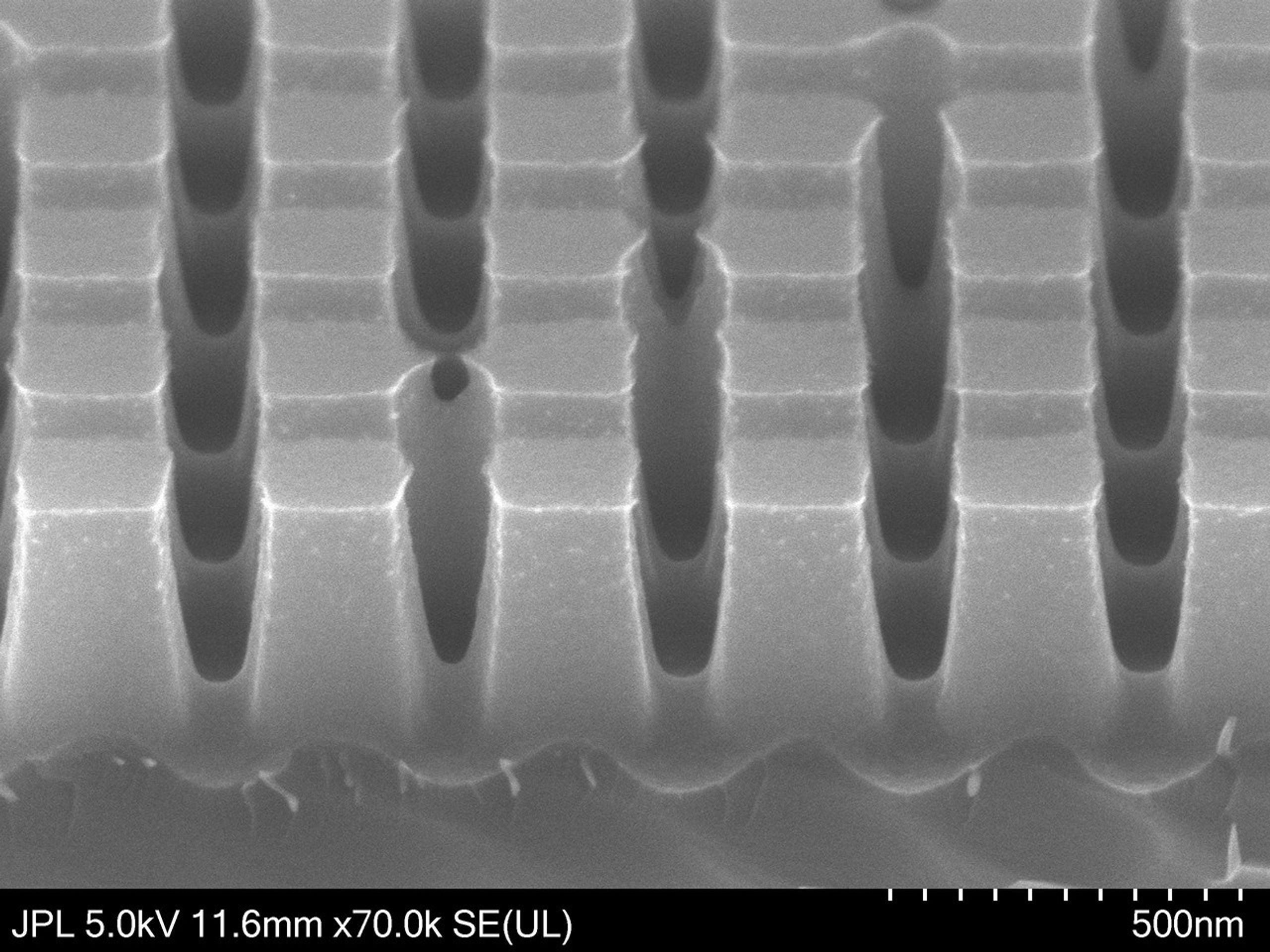
At the same time, the team is also looking into alternative mask approaches with different advantages and disadvantages. In particular, they have been revisiting the idea of shaping the surface of a piece of glass to look like a helical turn of a screw. However, this design will only work across multiple wavelengths if one combines several different pieces of glass, each with its own screw height, and if further deformations of the surface shape are also implemented. Moreover, since only a rather small number of materials seem to have the characteristics required for this design, it is not yet clear what ultimate performance can be achieved by this technique. As a result, the team is also looking into fabricating their own artificial materials (i.e., metamaterials) for use in such masks. Metamaterials are thin layers of tiny nanoposts (see figure below) in which the nanopost heights, widths, shapes, and spacings can be selected to generate material properties that do not exist in nature. While this approach is very new, it is conceivable that it could be used to tailor materials that have the characteristics needed to make optical vortex masks work over a wide range of wavelengths.
Optical vortex coronagraphs are becoming increasingly popular in the hunt for larger (brighter) exoplanets using ground-based telescopes, but seeing dimmer Earth-like exoplanets with a space-based telescope such as HWO will require vortex masks with vastly improved starlight rejection capabilities. While the liquid crystal polymer approach is the clear frontrunner, such masks also have limitations, so it is good that other possibilities are being investigated. These candidate technologies will be fully vetted and tested over the next few years to enable the fabrication of the optical vortex masks needed to be able to pick out and characterize nearby Earth-like exoplanets with HWO.
For additional details, see the entry for this project on NASA TechPort.
Project Lead(s): Eugene Serabyn, NASA Jet Propulsion Laboratory, California Institute of Technology, and Dimitri Mawet, California Institute of Technology
Sponsoring Organization(s): NASA Astrophysics Division Strategic Astrophysics Technology (SAT) and Astrophysics Research and Analysis (APRA) programs.
Part of this research was carried out at the Jet Propulsion Laboratory, California Institute of Technology, under contract with NASA (80NM0018D0004)