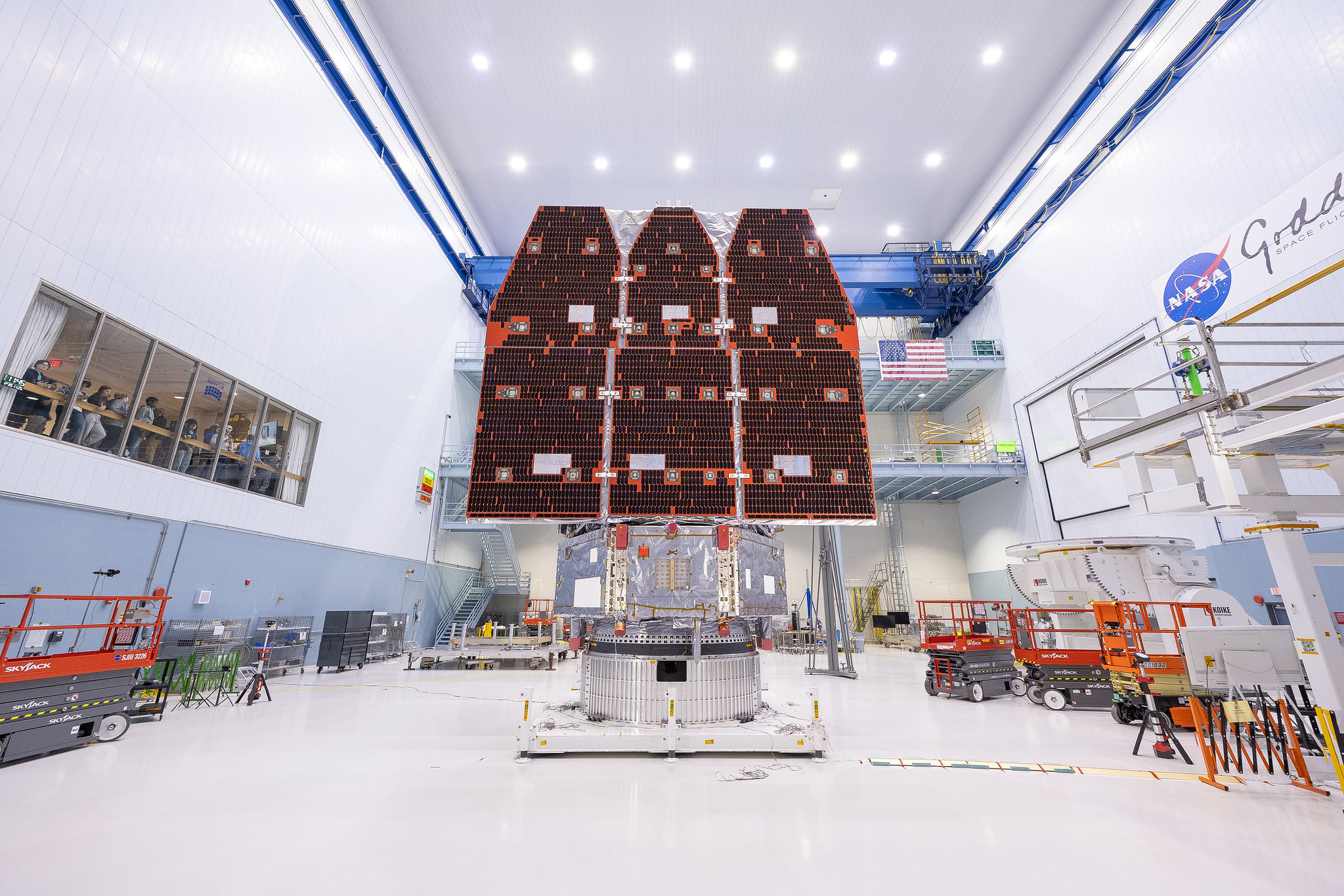
Media are invited Tuesday, April 21, to NASA’s Goddard Space Flight Center in Greenbelt, Maryland, for a look at the agency’s Nancy Grace Roman Space Telescope, which recently completed construction and is wrapping up prelaunch testing. This will be one of the last opportunities to view the fully integrated flagship telescope before it ships to NASA’s Kennedy Space Center in Florida ahead of a launch planned as early as this fall.
With NASA Goddard’s largest clean room as a backdrop, the event will include a news conference at 4 p.m. EDT, which will stream on NASA’s YouTube channel. Learn how to stream NASA content through a variety of online platforms, including social media.
NASA participants in the briefing include:
- NASA Administrator Jared Isaacman
- Nicky Fox, associate administrator, Science Mission Directorate, NASA Headquarters, Washington
- Jamie Dunn, Roman telescope project manager, NASA Goddard
- Julie McEnery, Roman telescope senior project scientist, NASA Goddard
Media interested in participating by phone must RSVP no later than two hours prior to the start of the briefing to Alise Fisher, alise.m.fisher@nasa.gov. A copy of NASA’s media accreditation policy is online.
Credentialed media in attendance also will have the opportunity to visit other center facilities and conduct interviews with subject matter experts on topics such as NASA’s Lunar Environment Monitoring Station candidate payload for the Artemis program, the DAVINCI mission to Venus, the Habitable Worlds Observatory mission concept, and the Dragonfly mission to Saturn’s moon Titan.
To be considered for on-site credentials, foreign national media must register by Wednesday, April 1; U.S. media must register by Friday, April 10. Any media RSVPs must be sent to Rob Garner, rob.garner@nasa.gov.
Named after NASA’s first chief astronomer, the Nancy Grace Roman Space Telescope will have a deep, panoramic view of the cosmos, generating never-before-seen pictures that will revolutionize our understanding of the universe. The observatory will usher in a new era of cosmic surveys, unveiling troves of celestial objects and shedding light on some of the universe’s most profound mysteries, including phenomena we can’t see. Roman will also showcase cutting-edge technology, including a test of the most advanced technology ever flown in space to directly image planets around nearby stars, a key step in NASA’s search for life on other worlds.
The Roman telescope is managed at NASA Goddard with participation by the agency’s Jet Propulsion Laboratory in Southern California; Caltech/IPAC in Pasadena, California; the Space Telescope Science Institute in Baltimore; and a science team comprising scientists from various research institutions. The primary industrial partners are BAE Systems Inc. in Boulder, Colorado; L3Harris Technologies in Rochester, New York; and Teledyne Scientific & Imaging in Thousand Oaks, California. Contributions to Roman also are made by ESA (European Space Agency), JAXA (Japan Aerospace Exploration Agency), the French space agency CNES (Centre National d’Études Spatiales), and the Max Planck Institute for Astronomy in Germany.
For more information about NASA’s Roman telescope, visit:
-end-
Bethany Stevens / Alise Fisher
Headquarters, Washington
202-358-1600
bethany.c.stevens@nasa.gov / alise.m.fisher@nasa.gov
Claire Andreoli / Rob Garner
Goddard Space Flight Center, Greenbelt, Md.
301-286-1940 / 301-286-5687
claire.andreoli@nasa.gov / rob.garner@nasa.gov