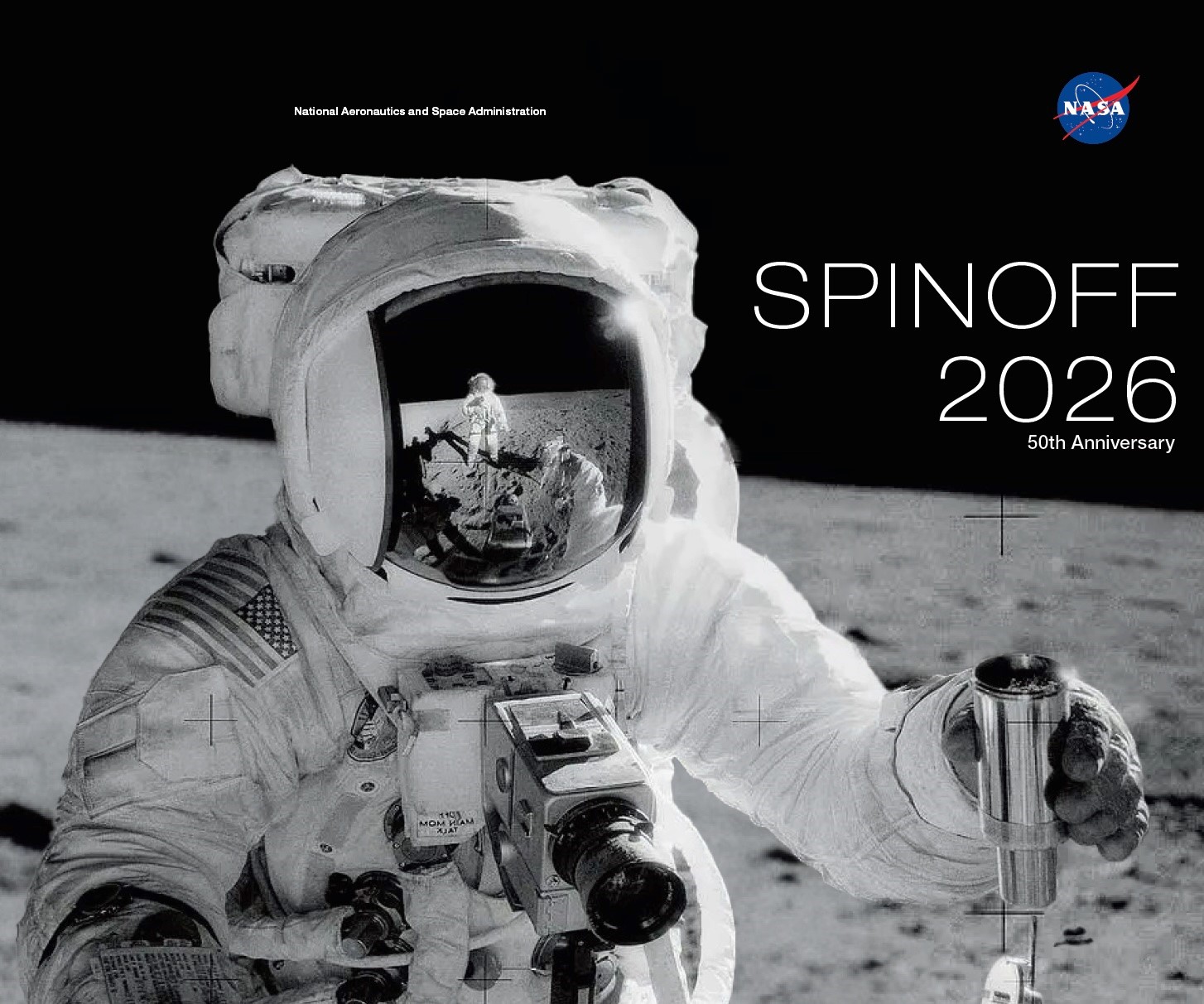
As NASA fosters technologies needed to live and work farther away from home than ever before, the agency’s Technology Transfer program has the sole mission of getting those innovations into the hands of companies, entrepreneurs, and, ultimately, everyday people. The agency’s Spinoff publication has captured this endeavor for half a century, sharing stories of space technologies improving our lives on Earth.
“NASA’s work has always delivered returns well beyond the mission itself,” said NASA Administrator Jared Isaacman. “As we develop the technologies needed for a sustained presence on the Moon and prepare for human exploration of Mars, those innovations will continue to unlock new capabilities across medicine, aviation, agriculture, and other critical sectors, delivering lasting benefits to Earth well beyond the mission.”
Many technologies created to support deep space and lunar missions, including Artemis, are in use on Earth. Spinoff’s 50th edition tells the stories of two companies that developed equipment to 3D print habitats on planetary surfaces. On Earth, one of those companies is custom-building wall panels, cladding, and facades, while the other is additively manufacturing entire neighborhoods of affordable housing.
NASA envisions a future where robots handle routine maintenance and mundane tasks to support astronauts during lunar missions. Two companies featured in Spinoff 2026 received the agency’s support to meet that need, and each has already found applications for their technology on Earth. One company is commercializing software to power robots that are cleaning bathrooms and building homes, and the other has created a humanoid robot capable of warehouse and assembly line tasks.
“Incredible feats on distant worlds require incredible innovation,” said Dan Lockney, Technology Transfer program executive at NASA Headquarters in Washington. “We can’t wait to see what breakthroughs and advancements come from not just exploration on the lunar surface but missions to put a rotorcraft on Saturn’s moon Titan or study interstellar objects in deep space.”
Any NASA work can result in spinoff technology, including lifesaving inventions. Technology developed by engineers trying to make life easier for astronauts on the International Space Station has evolved into an implantable heart monitor that’s helping keep heart failure patients out of the hospital. Companies also are improving personal locator beacons for search and rescue networks based on NASA’s satellite communication technology.
Standout spinoffs
Procedures NASA created to ensure food safety for Apollo astronauts traveling to the Moon formed the foundation for safety procedures and regulations governing food production globally. The memory foam found in mattresses today originated from NASA’s development of pressure-absorbing materials for aircraft seats in the 1970s. Miniaturized, energy-efficient camera technology, initially engineered by NASA to create compact, high-quality imaging systems for spacecraft, is now the basis for modern digital imagery, from smartphone cameras to cinema. Scratch-resistant lenses use diamond-hard coatings originally developed for aerospace applications, and wireless headsets are rooted in technology NASA pioneered to enable hands-free communication for astronauts.
Readers of Spinoff 2026 are invited to contribute to the next “small step” in NASA’s history of “giant leaps” and bring space-inspired technology to Earth. In this edition’s Spinoffs of Tomorrow section, there are 20 technologies ready for commercialization, with information on how to license them or any of the other 1,300 inventions available in NASA’s Patent Portfolio.
Spinoff is part of NASA’s Space Technology Mission Directorate and its Technology Transfer program. Technology Transfer is charged with finding broad, innovative applications for NASA-developed technology through partnerships and licensing agreements, ensuring agency investments benefit the nation and the world.
To read NASA’s 50th edition of Spinoff, visit:
-end-
Jasmine Hopkins
Headquarters, Washington
321-432-4624
jasmine.s.hopkins@nasa.gov