The Discovery
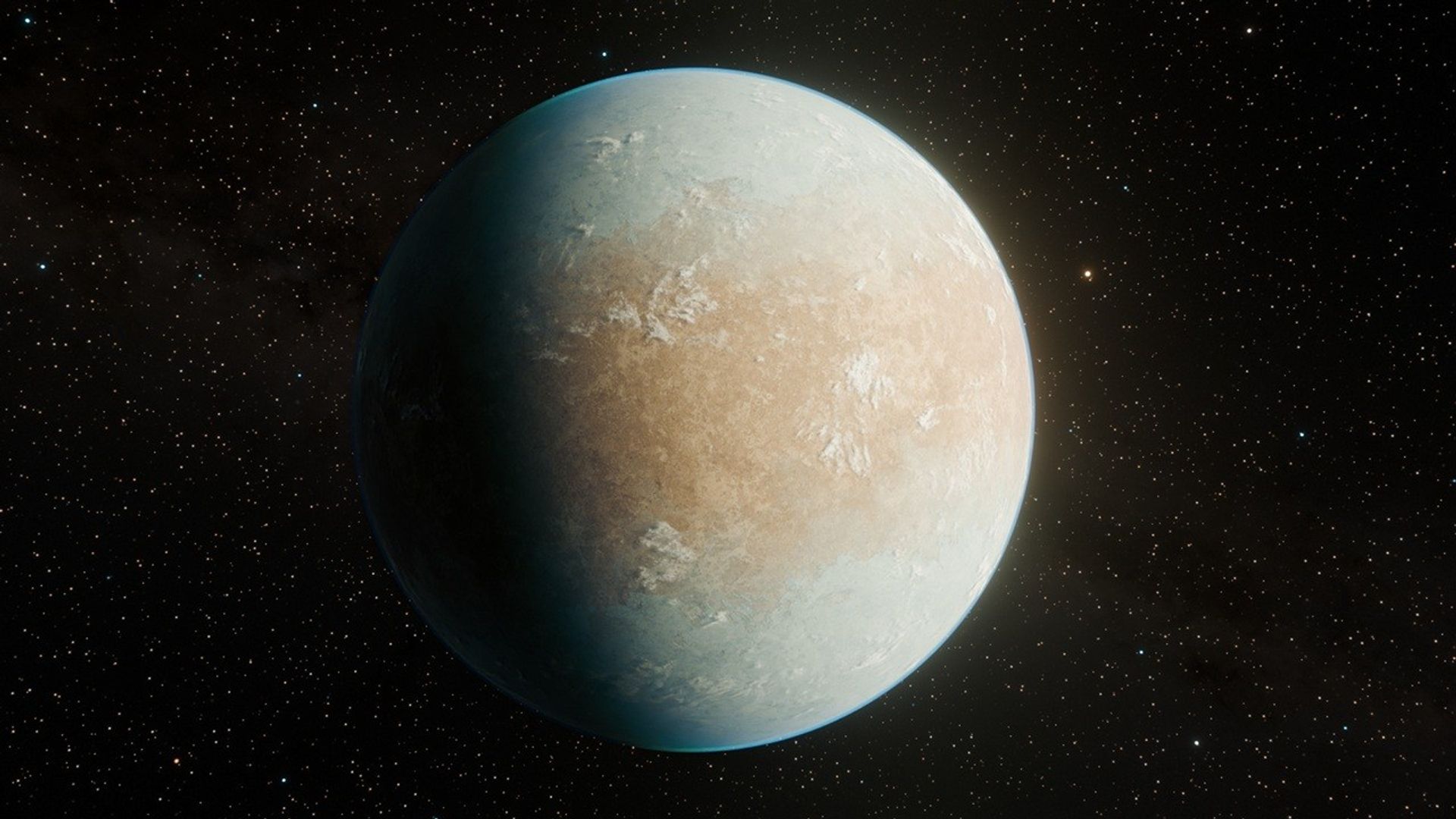
A candidate planet that might be remarkably similar to Earth, HD 137010 b, has one potentially big difference: It could be colder than perpetually frozen Mars.
Key Facts
Scientists continue to mine data gathered by NASA’s Kepler Space Telescope, retired in 2018, and continue to turn up surprises. A new paper reveals the latest: a possible rocky planet slightly larger than Earth, orbiting a Sun-like star about 146 light-years away.
The orbital period of the planet — listed as a “candidate” pending further confirmation — is likely to be similar to Earth’s, around one year. Planet HD 137010 b also might fall just within the outer edge of its star’s “habitable zone,” the orbital distance that could allow liquid water to form on the planet’s surface under a suitable atmosphere.
Planets orbiting other stars are known as “exoplanets.” And this could turn out to be the first exoplanet with Earth-like properties that, from our vantage point, crosses the face of a Sun-like star that is near enough and bright enough for meaningful follow-up observations.
Details
Now the bad news. The amount of heat and light such a planet would receive from its star is less than a third of what Earth receives from the Sun. Although of a stellar type similar to our Sun, the star, HD 137010, is cooler and dimmer. That could mean a planetary surface temperature no higher than minus 90 degrees Fahrenheit (minus 68 degrees Celsius). By comparison, the average surface temperature on Mars runs about minus 85 degrees Fahrenheit (minus 65 degrees Celsius).
Planet HD 137010 b also will need follow-up observations to be promoted from “candidate” to “confirmed.” Exoplanet scientists use a variety of techniques to identify planets, and this discovery comes from a single “transit” — only one instance of the planet crossing its star’s face in a kind of miniature eclipse — detected during Kepler’s second mission, known as K2. Even with just one transit, the study’s authors were able to estimate the candidate planet’s orbital period. They tracked the time it took for the planet’s shadow to move across the star’s face — in this case 10 hours, while Earth takes about 13 — then compared it to orbital models of the system itself. Still, though the precision of that single detection is much higher than most transits captured by space-based telescopes, astronomers need to see these transits repeat regularly in order to confirm that they are caused by a real planet.
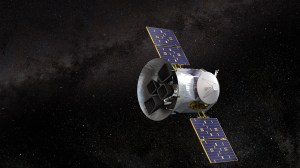
And capturing more transits is going to be tricky. The planet’s orbital distance, so similar to Earth’s, means such transits happen far less often than for planets in tighter orbits around their stars (it’s a big reason why exoplanets with Earth-like orbits are so hard to detect in the first place). With luck, confirmation could come from further observation by the successor to Kepler/K2, NASA’s TESS (the Transiting Exoplanet Survey Satellite), the still-functioning workhorse for planetary detection, or from the European Space Agency’s CHEOPS (CHaracterising ExOPlanets Satellite). Otherwise, gathering further data on planet HD 137010 b might have to wait for the next generation of space telescopes.
Fun Facts
Despite the possibility of a frigid climate, HD 137010 b also could turn out to be a temperate or even a watery world, say the authors of the paper on this exoplanet. It would just need an atmosphere richer in carbon dioxide than our own. The science team, based on modeling of the planet’s possible atmospheres, gives it a 40% chance of falling within the “conservative” habitable zone around the star, and a 51% chance of falling within the broader “optimistic” habitable zone. On the other hand, the authors of the study say the planet has about a 50-50 chance of falling beyond the habitable zone entirely.
The Discoverers
An international science team published a paper on the discovery, “A Cool Earth-sized Planet Candidate Transiting a Tenth Magnitude K-dwarf From K2,” in The Astrophysical Journal Letters on Jan. 27, 2026. The team was led by astrophysics Ph.D. student Alexander Venner of the University of Southern Queensland, Toowoomba, Australia, now a postdoctoral researcher at the Max Planck Institute for Astronomy, Heidelberg, Germany.