5 min read
Astronomy Activation Ambassadors: Embracing Multiple Perspectives
The Astronomy Activation Ambassadors (AAA) project, part of the NASA Science Activation program, aims to measurably enhance student STEM (Science, Technology, Engineering, & Mathematics) engagement via middle school, high school, and community college science teacher professional development. AAA participants draw on NASA resources and subject matter experts to enhance their teaching and help share their excitement about astronomy and planetary science with their students. An important component of AAA teacher professional development is STEM immersion experiences, including guided tours of working observatories.
Teacher visits to observatories offer a rare chance to connect science with history, culture, and place. Framing those visits around the historical context of astronomy and the cultural significance of “high places” helps students see science as a human endeavor shaped by many voices. People everywhere look to the sky for meaning and knowledge, and mountain peaks often carry spiritual, cultural, and historical weight for local communities. The significance of these locations can be shared with their students.
AAA STEM immersion experiences took place in Hilo, Hawaii, and Tucson, Arizona, respectively, in April and September 2025. During the weekend of April 12-13, 16 teachers from across the state of Hawai`i gathered in Hilo for a full agenda involving a hands-on electromagnetic spectrum and multiwavelength astronomy curriculum workshop, subject matter expert presentations regarding astronomy research and native Hawaiian perspectives on Maunakea, and a visit to the summit of Maunakea (Figures 1 & 2). Teacher participants expressed their appreciation especially for the summit visit portion of the workshop and had numerous discussions during the journey about ways they could incorporate this content into their teaching.
The tour paused on the way up the mountain at the mid-level Onizuka Visitors Center. There, workshop participant, local high school teacher, and native Hawaiian cultural practitioner Toni Kaui addressed the group: “Standing here, we have passed through the wao kele (vah-oh kay-lay; forested uplands) and are about to enter the wao akua (vah-oh ah-koo-ah), the heavenly realm where our spirits and our elements of sacredness lie. […] This is where we come to have our spiritual connection with the mauna (mountain). In the wao akua, all of our sacred and elemental processes happen, and those processes help to determine the well-being of our ‘aina (-eye-nah; homeland) down below in the wao kanaka (vah-oh kah-nah-kah; human realm) where we came from.”


The Maunakea visit was recorded by the NASA Science Activation program’s Infiniscope (Arizona State University) team, who joined AAA in the production of a virtual (video) tour highlighting both native Hawaiian and scientific researcher respect for the mountain. The virtual tour will be placed in the Infiniscope library (https://infiniscope.org) to be shared with a world-wide public audience.
The AAA program’s final workshop and STEM immersion experience was offered September 13-14 to 25 teachers from throughout the U.S. at the National Science Foundation’s NOIRLab headquarters in Tucson, Arizona and at Kitt Peak National Observatory (Figure 3).

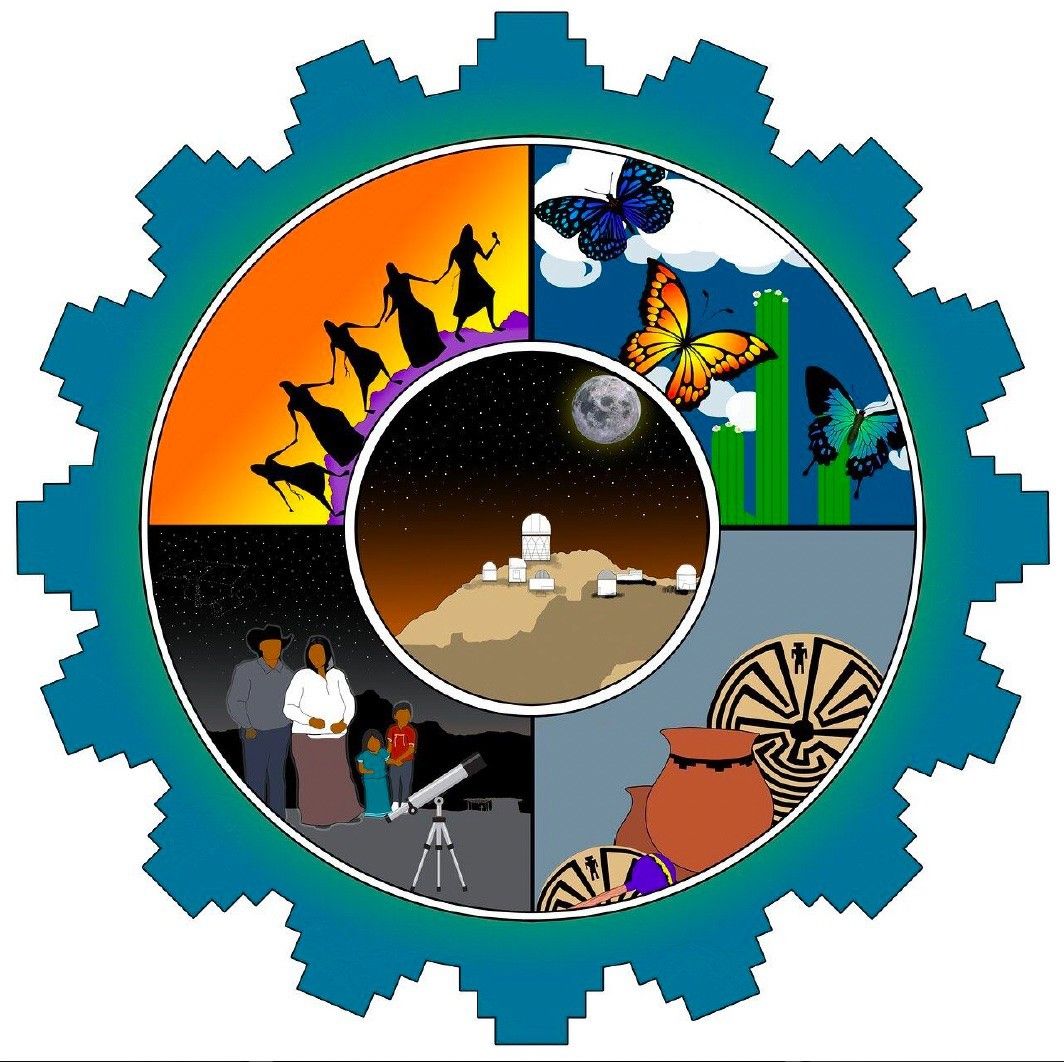
Kitt Peak National Observatory is located within the land of the Tohono O’odham (tuh-hoh-noh aw-tuhm) Native American tribe, whose name for Kitt Peak is I’oligam Du’ag (ee-oh-lih-gahm doo-ahg), meaning “Manzanita Shrub Mountain”. Dr. Jacelle Ramon-Sauberan, Tohono Oʼodham Education Development Liaison with the NOIRLab, spoke with workshop participants regarding the long history of productive collaboration between local indigenous authorities and organizations developing and managing astronomy facilities on the mountain (Figure 4). She noted that the lease agreement between the Tohono O’odham nation and the NSF: “… is in perpetuity, as long as the mountain is used for astronomical study and research/education.” The AAA participant teachers found Dr. Ramon-Sauberan so inspiring that they enthusiastically gave up part of their scheduled lunch hour so she could have more time for her presentation.
The AAA project is winding down operations after 10 years as an active part of the NASA Science Activation’s collective efforts. In 2025, the ensemble of SciAct projects reached millions of learners in the U.S. and around the world via web-based content, public events, and education resources. As of the end of 2025, the AAA project alone had 780 teacher participants in 46 U.S. states plus 10 countries; 420 teachers have received STEM immersion experiences including flights on NASA’s Stratospheric Observatory for Infrared Astronomy (SOFIA) or visits to ground-based observatories. An estimated 70,000 students nation-wide have been influenced and inspired by AAA educators.
Participant or Team Member Quotes
Lillian Reynolds, Hawai`i middle school science teacher, stated: “I was fortunate to go to this STEM experience at Maunakea. One thing that I learned is about how many other jobs and people it takes to run all the telescopes and everything up there. I had this preconceived idea that it’s mostly astronomers, PhD people that I didn’t really relate to. I got to meet a lot of the technicians and other folks and that really opened my eyes to other opportunities for my students. So, that’s what I’m looking forward to taking back. It made me feel hopeful that we can really increase our base of home-grown scientists here in Hawai`i.”
Olivia Kuper, Tennessee high school science teacher, noted: “The inclusion of the Indigenous history and perspectives connected to Kitt Peak was one of the most important aspects of the training for me. It reinforced the importance of teaching astronomy in ways that respect the land and the people tied to it. This approach deepened my understanding and will help my students recognize the value of cultural perspectives and historical context in scientific practice.”