5 min read
NASA-JAXA’s XRISM Telescope Clocks Hot Wind of Galaxy M82
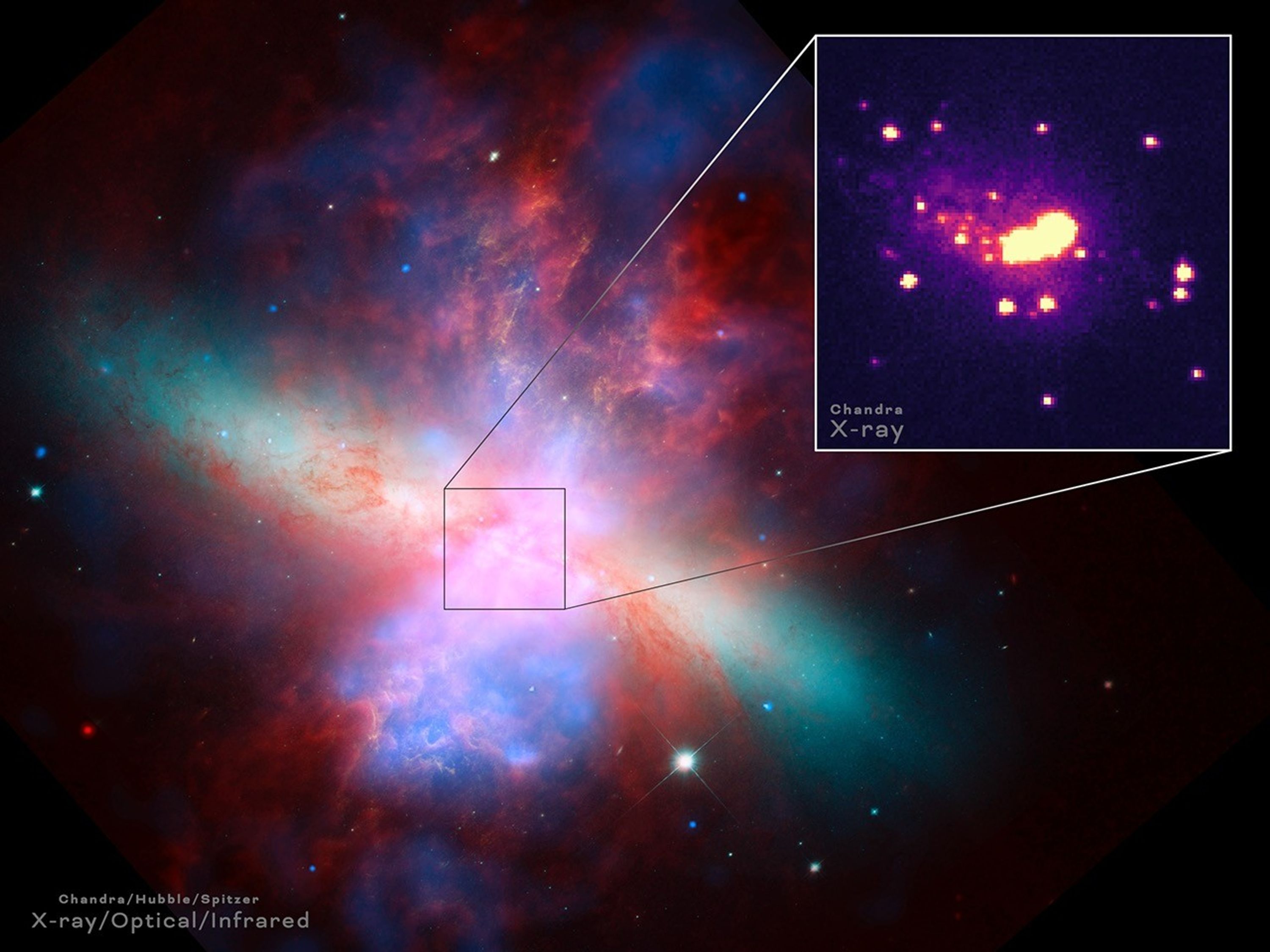
For the first time, astronomers have directly measured the speed of superheated gas billowing from a cauldron of stellar activity at the heart of M82, a nearby galaxy undergoing an extraordinary burst of star formation.
The material is moving more than 2 million miles (over 3 million kilometers) per hour and appears to be the primary force driving a cooler, well-studied, galaxy-scale wind.
Researchers made the calculations using data from the Resolve instrument aboard the XRISM (X-ray Imaging and Spectroscopy Mission) spacecraft.
“The classic model of starburst galaxies like M82 suggests that shock waves from star formation and supernovae near the center heat gas, kick-starting a powerful wind,” said Erin Boettcher, an astrophysicist at the University of Maryland, College Park and NASA’s Goddard Space Flight Center in Greenbelt, Maryland. “Prior to XRISM, though, we didn’t have the ability to measure the velocities needed to test that hypothesis. Now we see the gas moving even faster than some models predict, more than enough to drive the wind all the way to the edge of the galaxy.”
A paper about the result, led by Boettcher, published Wednesday, March 25, in Nature. The XRISM mission is led by JAXA (Japan Aerospace Exploration Agency) in collaboration with NASA, along with contributions from ESA (European Space Agency). NASA and JAXA also codeveloped the Resolve instrument.

Sometimes called the Cigar galaxy, M82 is located 12 million light-years away in the northern constellation Ursa Major. Astronomers classify it as a starburst galaxy because it’s forming stars at a much higher rate than typical for its size — about 10 times faster than the Milky Way.
M82 is well known for its extended, cool wind, which stretches out to 40,000 light-years and propels huge quantities of gas and dust. Scientists have studied it with many missions, including NASA’s Chandra, Webb, Hubble, and retired Spitzer space telescopes, trying to connect the dots between the stellar activity and the large-scale outflow.
Researchers particularly want to understand the role of cosmic rays. These high-speed charged particles are found throughout the cosmos and are accelerated by some of the same events scientists think produce winds like in M82. There’s a possibility they are a main source of outward pressure on the gas.
The XRISM Resolve instrument’s high resolution and sensitivity allowed Boettcher and her colleagues to accurately measure the speed of the hot wind by looking at an X-ray signal from superheated iron in the galactic center.
The amount of X-ray light from iron and other elements told them the temperature — right within predictions at 45 million degrees Fahrenheit (25 million degrees Celsius). The heat exerts pressure on the gas and pushes it outward. This rushing from high pressure to low pressure forms the wind — the same reason winds blow through Earth’s atmosphere.
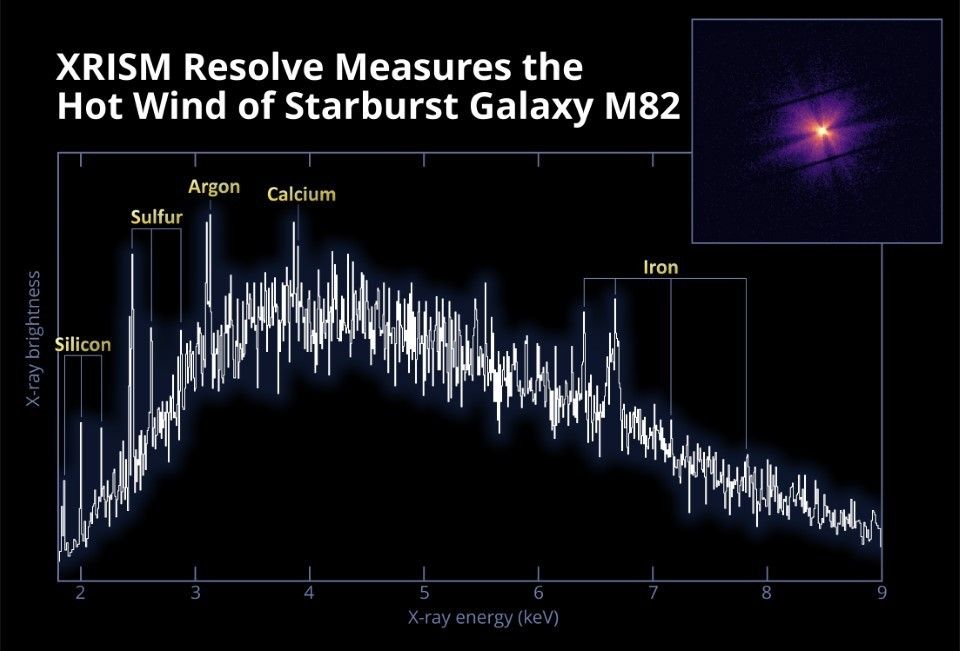
The broadness of iron spectral lines conveyed the hot wind’s speed. This works through Doppler shifting, the same phenomenon that causes the pitch of a sound, like a siren, to rise or fall due to the source’s motion toward or away from you. In the case of M82, the hot material near the center flies quickly in both directions, stretching out the iron’s spectral line. The amount of stretching reveals the iron’s velocity. The researchers found that the wind is a little faster than expected. Combined with the high temperature, it’s powerful enough to produce the cool wind without cosmic rays, although they may still be contributing.
The researchers calculate that the center of M82 expels enough gas every year to form seven stars with the mass of our Sun. This presents another puzzle.
“If the wind blows steadily at the speed we’ve measured, then we think it can power the larger, cooler wind by driving out four solar masses of gas a year. But XRISM tells us much more gas is moving outward,” said co-author Edmund Hodges-Kluck, an astronomer and XRISM team member at NASA Goddard. “Where do the three extra solar masses go? Do they escape out of the galaxy as hot gas some other way? We don’t know.”
The XRISM satellite’s observations of M82 will help improve models of starburst galaxies, which may help scientists answer these types of questions in the future. NASA’s contributions to international projects like XRISM are part of the agency’s efforts to innovate with ambitious science missions that will help us better understand how our cosmos works.
“Some of our early models of starburst galaxies were developed in the 1980s, and we’re finally able to test them in ways that weren’t possible before XRISM,” said co-author Skylar Grayson, a graduate student at Arizona State University in Tempe. “It provides opportunities to figure out why the model might not be capturing everything that’s going on in the real universe.”
By Jeanette Kazmierczak
NASA’s Goddard Space Flight Center, Greenbelt, Md.
Media Contact:
Claire Andreoli
301-286-1940
NASA’s Goddard Space Flight Center, Greenbelt, Md.